Jacksonville treatment guide
Leg Swelling in Jacksonville: Often a Vascular Problem — and Often Very Treatable
Swollen ankles and lower legs at the end of the day are easy to dismiss — too much standing, too much salt, just getting older. But chronic leg swelling is one of the most common symptoms of vein disease, and it deserves a real answer.
At Miami Vein and Wellness, Jacksonville, leg swelling is evaluated with a complete clinical history and in-office vascular ultrasound — giving you answers the same day.
Book a consultationMedically reviewed by Jose I. Almeida, MD, FACS, RPVI, RVT — Vascular Surgery, medical director

Why Miami Vein and Wellness, Jacksonville
Same-day ultrasound answers
In-office duplex mapping finds the cause.
10,000+ vein procedures
16 years of exclusive vein specialization.
Whole-body evaluation
Labs catch drivers beyond your veins.
Treatment for this concern
Chronic Venous Insufficiency
Insurance-covered
About the treatment Book a consultationOr call/text (904) 310-7186.
When Leg Swelling Is a Vein Problem
Leg swelling — particularly in the ankles and lower legs at the end of the day — is one of the most common symptoms of chronic venous insufficiency. When vein valves fail to close properly, blood pools in the lower extremities. The resulting increase in venous pressure pushes fluid into surrounding tissue, causing the swelling and heaviness that many patients have learned to live with.
Venous leg swelling tends to worsen with prolonged standing or sitting, improve with leg elevation, and progress gradually over time. It is often accompanied by aching, skin changes, or visible varicose veins — but not always. Swelling can be the only outward sign of significant venous disease.
While vein disease is a common cause of leg swelling, other conditions can also contribute — including heart, kidney, or lymphatic conditions. Sudden swelling in one leg, especially with warmth or pain, can signal a blood clot and deserves prompt medical attention. A thorough evaluation, including vascular ultrasound, helps identify the source and guide treatment.
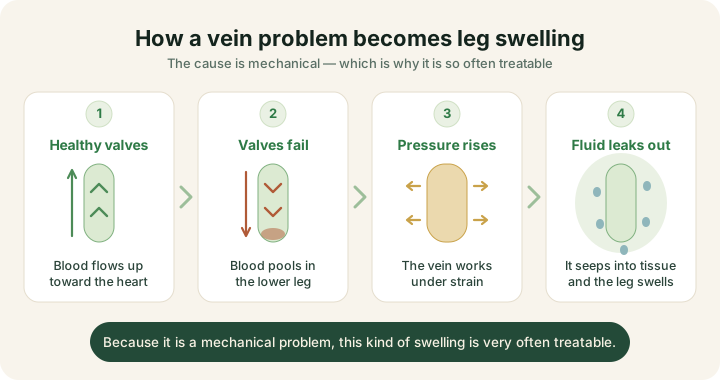
Clues That Point Toward a Venous Cause
No single sign is definitive — that is what the ultrasound is for — but these patterns make a venous cause more likely.
Worse by evening, better by morning
Swelling that builds through the day and resolves overnight tracks with gravity and pooling blood — the signature of venous pressure rather than a systemic cause.
Improves when you elevate your legs
If propping your legs up visibly reduces the swelling, the fluid is following venous pressure — a strong clue the veins are involved.
Worse with prolonged standing or sitting
Long shifts on your feet or at a desk give blood more time to pool. Teachers, nurses, retail and hospitality workers, and frequent travelers notice this pattern most.
Accompanied by aching or heaviness
Swelling that arrives with tired, heavy, aching legs points toward chronic venous insufficiency rather than an isolated fluid issue.
Skin changes around the ankles
Darkening, thickening, or itching skin near the ankles means venous pressure has been elevated for a long time — a finding that moves evaluation from optional to important.
Visible varicose or spider veins
Surface veins alongside swelling suggest the valves underneath are struggling. The swelling and the veins usually share the same cause.
Sudden swelling in one leg
One-sided swelling that appears quickly — especially with warmth, redness, or pain — can signal deep vein thrombosis (DVT) and should be evaluated promptly. Ultrasound is the standard test.
How We Evaluate and Treat Leg Swelling in Jacksonville
At Miami Vein and Wellness, Jacksonville, leg swelling is evaluated with a complete clinical history and in-office vascular duplex ultrasound. We assess venous anatomy, identify reflux, and rule out deep vein thrombosis — giving you answers the same day, with no separate imaging appointment. It is part of our broader vein care program, where diagnosis and treatment happen under one roof.
When the ultrasound confirms chronic venous insufficiency, treatment is tailored to the severity of your disease: compression therapy as the first-line step, radiofrequency ablation or laser ablation to close refluxing veins at the source, and follow-up imaging to confirm results.
When the cause is not venous, you still leave with real information. Ruling vein disease in or out narrows the search meaningfully, and we coordinate with your primary physician so the next step — cardiac, renal, or lymphatic evaluation — is clear rather than another guess.
Treatment for venous causes of leg swelling is covered by most major insurance plans, including Medicare, when medical necessity criteria are met. Our team verifies your coverage and manages prior authorization.
Stop Guessing Why Your Legs Are Swelling
One in-office ultrasound rules the most common cause in or out — with results the same day, not weeks from now.
Book a vein evaluationFrequently asked questions
When should I worry about leg swelling?
Seek prompt medical attention for sudden swelling in one leg — especially with warmth, redness, or pain — which can signal a blood clot, or for swelling with shortness of breath or chest pain.
Gradual, both-leg, end-of-day swelling is rarely an emergency, but it is not normal either. It deserves an evaluation, because the most common cause — venous insufficiency — is progressive and treatable.
Why do my legs swell at the end of the day but look normal in the morning?
That daily rhythm is gravity at work on failing vein valves. Upright all day, blood pools and pressure pushes fluid into the tissue; lying down overnight, the fluid drains back. The pattern is reassuring in one sense — it points away from systemic causes — but it is also the classic signature of chronic venous insufficiency.
Can vein problems cause swelling even without visible varicose veins?
Yes. The veins driving venous insufficiency sit deep enough that the disease can be invisible from the outside. Swelling, heaviness, and aching can be the only symptoms — which is why diagnosis depends on duplex ultrasound, not on what the legs look like.
What will happen at my evaluation?
A focused history and exam, then an in-office vascular duplex ultrasound — a comfortable, non-invasive study that takes about 30 to 45 minutes. It maps your vein anatomy, identifies reflux, and rules out deep vein thrombosis.
Results are reviewed with you immediately, and if treatment is indicated, we verify your insurance coverage before recommending anything.
Do compression stockings fix the problem?
Compression is genuinely helpful — it supports the veins, limits pooling, and reduces daily swelling — and most insurers require trying it first. But it manages the pressure rather than fixing the valves.
If swelling persists despite compression, treating the underlying reflux with ablation addresses the cause.
Is the evaluation covered by insurance?
Diagnostic vascular ultrasound for leg swelling is covered by most major insurance plans, including Medicare, when clinically indicated — and persistent unexplained swelling generally qualifies. Our team verifies your specific benefits before your visit.
Chronic Venous Insufficiency is available at our St. Johns County office in the Durbin Park area — serving Jacksonville, St. Johns, Ponte Vedra, Mandarin, Durbin, Silverleaf, Nocatee, Julington Creek, Fleming Island, and St. Augustine.
If Your Legs Have Been Swelling and You're Not Sure Why
A vein evaluation is a good place to start. The most common cause of chronic leg swelling is venous — and the venous causes are the treatable ones.
We see patients from throughout St. Johns County — Nocatee, Durbin Crossing, Ponte Vedra, St. Augustine — and greater Jacksonville. Book a consultation today.
Book a consultationOr call/text (904) 310-7186.
Sources & further reading
Independent clinical references
Published by medical societies and regulators with no connection to this practice.
- Chronic Venous Insufficiency — Society for Vascular Surgery
The vascular-surgery society on venous causes of chronic leg swelling.
- Deep Vein Thrombosis — Society for Vascular Surgery
Independent reference for the DVT warning signs listed above.
- Lymphedema — Society for Vascular Surgery
Distinguishes lymphatic swelling from venous swelling — they are treated differently.
From our Miami practices
Deeper clinical writing from our sister practices, Miami Vein Center and Miami Skin Spa.
- Chronic Venous Insufficiency Guide — Miami Vein Center
Venous-pump physiology, valve failure, and why venous pressure produces swelling.
- Understanding Vein Disease — Miami Vein Center
Overview of venous disease presentations, including swelling without visible veins.
- The Stages of Vein Disease — Miami Vein Center
Where swelling sits in disease progression — after surface veins, before skin damage and ulcers.
- Deep Vein Thrombosis (DVT) — Miami Vein Center
One-sided sudden swelling as a DVT warning sign and the role of duplex ultrasound.
- The Vascular Lab — Miami Vein Center
How accredited duplex ultrasound evaluation works at our sister practice.