What Is Chronic Venous Insufficiency? A St. Johns Guide
What Is Chronic Venous Insufficiency?
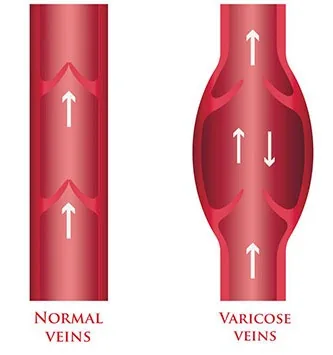
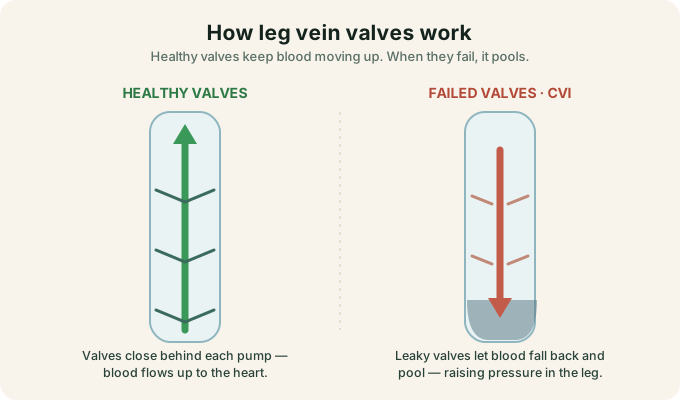
Chronic venous insufficiency (CVI) is a common circulation problem in which the tiny one-way valves inside your leg veins stop closing properly, so blood that should flow up toward your heart leaks backward and pools in the lower leg. That pooling raises the pressure inside your veins — a state called venous hypertension — and over time that pressure is what drives the swelling, aching, and skin changes many people notice. It can be a progressive condition, but it is also very treatable, and understanding it is the first step toward feeling better.
Normally, as the muscles in your calves contract when you walk, they squeeze your veins and push blood upward. The valves snap shut behind each pump so gravity can’t pull the blood back down. When those valves weaken or the vein walls stretch, that “check valve” system fails, blood lingers, and pressure builds. For some people, especially when it goes unmanaged, this cycle tends to nudge forward over time — which is why so many patients search for what CVI is only after months of quietly living with tired, heavy legs.
What Are the Symptoms?
CVI shows up differently from person to person, and early signs are easy to dismiss as simply getting older or standing too long. Common symptoms include:
- Swelling in the ankles and lower legs, often affecting both legs and usually worse at the end of the day or after long periods on your feet
- Heaviness, aching, or a tired feeling in the legs
- Itching or irritated, eczema-like skin, sometimes with a general restless feeling in the legs, though restlessness on its own is nonspecific and has many possible causes
- Varicose veins — the rope-like, bulging veins near the skin’s surface
- Skin changes near the ankle, such as darkening (a brownish discoloration), dryness, or a hardened, leathery texture
- In advanced, long-standing cases, venous leg ulcers — slow-to-heal open sores, usually around the inner ankle
Gradual, symmetric swelling in one or both legs is frequently one of the earliest clues, and it’s worth paying attention to rather than waiting for it to pass on its own. One important exception: new swelling in just one leg, or swelling that comes on suddenly, should be checked promptly to rule out a blood clot first — more on those warning signs below.
Is CVI Dangerous? Can You Die From It?
This is the question that brings a lot of worried people online at midnight, so let’s answer it honestly. In most cases, chronic venous insufficiency is not immediately life-threatening, and it is not something people typically “die from.” It is a chronic, manageable condition rather than an emergency.
That said, “not immediately dangerous” is not the same as “harmless.” When it’s left unmanaged, CVI can lead to real problems over time: persistent skin damage, hard-to-heal venous ulcers, and a higher chance of infections or blood-clotting issues in the affected veins. Well-managed CVI and neglected CVI can look very different a few years down the road, which is why evaluation matters even when symptoms feel minor.
CVI Is Not the Same as a DVT
It’s important not to confuse chronic venous insufficiency with a deep vein thrombosis (DVT) — a blood clot in a deep leg vein, which is a medical emergency because a clot can travel to the lungs. CVI develops gradually over months or years. A DVT tends to come on suddenly.
Seek urgent medical care right away if you notice:
- Sudden swelling in one leg (especially if it’s markedly different from the other)
- New calf pain, cramping, or tenderness that doesn’t fit your usual pattern
- Warmth, redness, or skin that feels hot over the area
- Any leg swelling paired with chest pain or shortness of breath — call emergency services
These red flags point toward a possible clot and shouldn’t wait for a routine appointment. CVI itself, by contrast, is something you and your provider can plan around thoughtfully.
What Causes CVI, and Who Is at Risk?
CVI develops when the valves or walls of your leg veins are damaged or weakened. Several factors can raise your likelihood of developing it, though having them doesn’t mean you definitely will:
- A family history of varicose veins or vein disease
- Age, as veins and valves naturally lose some elasticity over time
- Pregnancy, which increases blood volume and pressure on the leg veins
- Prolonged standing or sitting, common in many jobs
- Being overweight, which adds pressure to the lower-body veins
- A prior blood clot that damaged a deep vein
- Being assigned female at birth, and hormonal factors
Living in the warm, active climate of Northeast Florida doesn’t cause CVI, but heat can make swelling and heaviness feel more pronounced — one reason many St. Johns, Silverleaf, and Jacksonville residents notice symptoms most in the summer months.
Can CVI Be Reversed or Cured?
Here’s the nuance that’s worth understanding. Once a vein valve is truly damaged, it does not heal or grow back — so in that strict sense, CVI isn’t “reversed.” But this is genuinely reassuring news rather than discouraging, because the disease is highly manageable. Modern treatment doesn’t rely on repairing a valve; it reroutes blood flow away from the malfunctioning veins so your body naturally redirects it through healthy ones. Symptoms can improve substantially, and progression can often be slowed.
Depending on your evaluation, your provider can help determine which approach fits your situation. Options often include:
- Compression therapy — graduated compression stockings that support the calf pump and ease pooling, frequently a first step
- Endovenous ablation — a minimally invasive, in-office procedure that seals a diseased vein closed using heat or another energy source, so blood shifts to healthier veins
- Sclerotherapy — a solution injected into smaller problem veins to close them off
- Lifestyle measures — regular walking, elevating the legs, weight management, and moving often if you sit or stand for long stretches
Treatment is always individualized. What’s right for a person with mild aching differs from what’s right for someone with advanced skin changes, which is why a professional evaluation comes before any plan. You can read more about the full range of CVI treatment options and what each one involves.
How Is CVI Diagnosed?
You can’t confirm CVI by looking at the skin alone, because the underlying valve problem is beneath the surface. The standard tool is a duplex ultrasound — a comfortable, in-office scan that uses sound waves to watch blood flow in real time and show exactly which valves are leaking and how severely. There are no needles and no radiation; a technician simply glides a small probe along your leg while you rest. This comfortable vascular ultrasound exam maps your specific vein anatomy, and that map is what lets your provider recommend a treatment plan tailored to you rather than a generic one.
The Bottom Line
Chronic venous insufficiency is a common, often progressive, but very manageable condition where failing vein valves let blood pool and pressure build in the legs. It’s usually not an immediate danger to your life, but for many people it doesn’t tend to improve on its own, and the skin and comfort of your legs are worth protecting. The most helpful thing you can do is stop guessing — heavy, swollen, achy legs deserve a clear answer, and a straightforward ultrasound evaluation can give you one along with a plan that fits your body and your life. That evaluation is available at our St. Johns County office, serving patients from Jacksonville, Fruit Cove, Fleming Island, and St. Augustine.
Care is provided at our St. Johns County office in the Durbin Park area — serving Jacksonville, St. Johns, Ponte Vedra, Mandarin, Durbin, Silverleaf, Nocatee, Julington Creek, Fleming Island, and St. Augustine.
Ready to talk it through with a vein specialist?
Cristal Boatright, PA-C reviews your history and maps a plan built on real diagnostics — not a template.
Book a consultationOr call/text (904) 310-7186.
Sources & further reading
- Chronic venous insufficiency — Miami Vein Center
Our Miami sister practice's CVI overview.
- Varicose veins: overview & treatment — Miami Vein Center
The visible veins CVI often produces.