On Your Feet All Day in Jacksonville? What Long Shifts Do to Your Leg Veins
Does standing all day cause varicose veins?
Standing for long stretches does not create a vein problem out of nothing, but it is consistently associated with a higher rate of varicose veins and with worse symptoms in people who are already predisposed. The strongest predictor of varicose veins is family history — you inherit the vein wall and valve structure you were born with. What a job on your feet does is load that structure hard, every shift, for years. If your veins were going to give way eventually, standing work tends to bring the timeline forward and make the day-to-day symptoms louder.
That distinction matters, because it changes what you can do about it. You cannot change your genetics. You can change how you spend the twelve hours in between.
Why standing is harder on your veins than walking
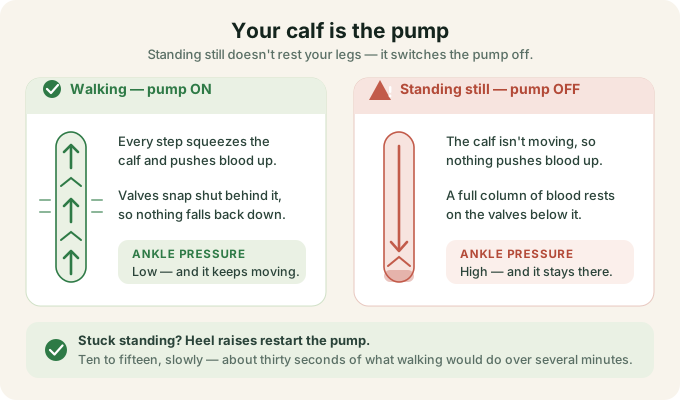
Your leg veins move blood uphill against gravity, and they get very little help from the heart at that distance. The real engine is your calf. Every step compresses the deep veins in the calf muscle and squeezes a column of blood upward, while one-way valves inside the vein snap shut behind it so the blood cannot fall back down. Vascular medicine calls this the calf muscle pump, and it is doing most of the work of returning blood from your legs.
Walking runs that pump continuously. Standing still switches it off while leaving the full weight of the blood column resting on the valves below. The pressure at your ankle when you are standing motionless is dramatically higher than when you are walking, and it stays there. Over years, that sustained pressure stretches vein walls. Once a vein has widened enough that its valve leaflets no longer meet in the middle, the valve leaks, blood falls backward, and the pressure below it climbs further. That backward flow is called venous reflux, and it is the mechanism behind most varicose veins.
This is why a nurse pacing a unit and a cashier standing at a register can have very different experiences of the same eight hours. Motion is protective. Static loading is not. It is also why sitting all day at a desk, while easier on the valves than standing, is not the answer either — a still calf is a still pump in both cases.
The pattern that shows up first
Long before there is a visible rope-like vein, most people notice a daily rhythm:
- Legs feel fine in the morning and heavy by the end of the shift. Overnight, lying flat lets the fluid and pressure resolve. The clock effectively resets, and the whole cycle repeats.
- Aching, throbbing, or a tight, full feeling in the calves rather than sharp pain.
- Socks leaving deeper marks at the ankle by evening.
- Relief from elevation. Putting your feet up genuinely helps, which is a useful clue — muscular and joint problems do not usually respond to elevation the way venous symptoms do.
- Worse in summer. Heat dilates veins, and a Northeast Florida August is a real aggravator for people who work outdoors or in a hot kitchen.
None of these are emergencies. But this is the stage where treatment is simplest, and it is the stage most people work through for a decade before mentioning it to anyone.
What compression actually does — and what it doesn’t
Graduated compression stockings are the first thing worth trying, and they are genuinely effective for symptoms. They apply the most pressure at the ankle and less as they move up the leg, which supports the vein walls and helps the calf pump work against a narrower vessel. For aching and end-of-day swelling during a long shift, most people who wear them consistently notice a difference.
What compression does not do is fix a leaking valve. The evidence that stockings prevent varicose veins from developing or stop existing ones from progressing is limited, and it is worth being straight about that rather than overselling them. Compression manages the symptom; it does not repair the underlying reflux. If your legs feel dramatically better in stockings and dramatically worse without them, that is not proof the problem is solved — it is a reasonable reason to find out what the valves are actually doing.
A practical note: fit matters more than brand. A stocking that is too tight at the calf band can create a tourniquet effect and do the opposite of what you want. Most people working full shifts do well in a 15–20 mmHg or 20–30 mmHg graduated stocking, but the right class depends on your legs and any arterial circulation issues, which is worth a conversation before you buy a case of them.
What to do during the shift
None of this requires equipment or a break room.
- Run the calf pump on purpose. Heel raises — up on the toes, down slowly, ten to fifteen at a time — do in thirty seconds what walking would do over several minutes. Do them whenever you are stuck standing in one spot.
- Shift your weight and change your stance rather than locking your knees. Locked knees are the worst position for venous return.
- Take the stairs, take the long hallway. Walking is the treatment; find excuses for it.
- Elevate on your break. Feet above heart level for even ten minutes drains the accumulated fluid meaningfully.
- Hydrate. Dehydration in Florida heat thickens blood and makes the whole system work harder, and it is easy to under-drink through a busy shift.
- Elevate at home, not just at work. Twenty minutes with your legs up when you get home is more useful than most of what people buy for tired legs.
Anti-fatigue mats and good footwear help comfort and help you keep moving, which is worth something. They are not doing anything directly to your veins.
When aching legs stop being normal fatigue
Tired legs after a long shift are ordinary. A few things are not, and they change the recommendation:
- Swelling that no longer fully resolves overnight. When you wake with an ankle that is still puffy, the system is no longer keeping up.
- Visible varicose veins that are enlarging, or veins that become firm, warm, and tender — that combination can indicate a clot in a superficial vein and should be looked at.
- Skin changes at the ankle — brown or rust-colored staining, dryness, itching, or skin that feels thickened and hard. These are signs of long-standing venous pressure and they are the stage before an ulcer. They warrant an evaluation rather than a wait-and-see.
- An open sore near the ankle that will not heal. This needs care now.
- Sudden swelling in one leg with pain, warmth, or redness, especially in the calf. This is the pattern that can indicate a deep vein thrombosis, a blood clot in a deep leg vein. Do not wait for an appointment — go to urgent care or the emergency room. If it comes with sudden shortness of breath or chest pain, call 911.
How we sort it out
The starting point is a duplex venous ultrasound. It is painless, requires no needles, dye, or radiation, and takes under an hour. Part of the study is done standing, which feels odd but is the point: reflux only reveals itself when gravity is loading the valves the way your workday does. The scan shows which veins are leaking, how badly, and in which direction — a map, not a guess.
If the ultrasound is clean, that is genuinely useful information, and the plan stays conservative: compression, movement, elevation. If it shows reflux in a saphenous vein, the modern fix is done in the office through a small puncture rather than in an operating room. Radiofrequency ablation uses controlled heat to seal the failed vein closed; endovenous laser ablation does the same thing with laser energy. Blood immediately reroutes into healthy deep veins, which is what it was already trying to do. Most people walk out and return to normal activity quickly — a meaningful consideration when you cannot take three weeks off a floor schedule.
Because these procedures treat a medical condition rather than a cosmetic one, they are frequently covered by insurance when symptoms and ultrasound findings support it. Most plans want a documented trial of conservative measures first, which is one more reason to start the compression conversation before you are desperate.
Getting looked at in St. Johns and Jacksonville
Our office is in the Durbin Park area of St. Johns, which puts us within a short drive of Julington Creek, Mandarin, Nocatee, Silverleaf, Fleming Island, Ponte Vedra, and the Southside — and Northeast Florida has no shortage of people who spend their working lives standing. If your legs have been aching through every shift for years and you have been treating it as the cost of the job, that is worth a second opinion. Aching legs are common. That does not make them normal, and it does not mean nothing can be done.
Care is provided at our St. Johns County office in the Durbin Park area — serving Jacksonville, St. Johns, Ponte Vedra, Mandarin, Durbin, Silverleaf, Nocatee, Julington Creek, Fleming Island, and St. Augustine.
Keep reading
Ready to talk it through with a vein specialist?
Cristal Boatright, PA-C reviews your history and maps a plan built on real diagnostics — not a template.
Book a consultationOr call/text (904) 310-7186.
Sources & further reading
- Varicose veins: overview & treatment — Miami Vein Center
How varicose veins form and what treatment involves.
- Vascular lab & duplex ultrasound — Miami Vein Center
How venous reflux is measured and mapped.
- The stages of vein disease — Miami Vein Center
How untreated venous pressure progresses to skin change and ulceration.
- When to treat varicose veins — Miami Vein Center
The threshold between conservative management and procedural treatment.
- Deep vein thrombosis — Miami Vein Center
The one-leg swelling pattern that needs urgent evaluation.