Perimenopause in Your 40s: What's Hormonal and What to Test in St. Johns
What are the symptoms of perimenopause in your 40s?
Hot flashes get all the attention, and they are often not the first thing to arrive. For most women the opening symptoms of perimenopause are sleep that fragments around 3 a.m., a shorter fuse than you recognize in yourself, brain fog that makes you lose the word you were reaching for, joint aches with no injury behind them, and a cycle that starts behaving differently — heavier, closer together, or unpredictable. These typically begin in the early-to-mid forties, several years before periods stop, and they are frequently attributed to stress, parenting, or work before anyone connects them to hormones.
That gap is the reason this is worth writing about. Perimenopause is not a narrow window right before menopause. It commonly runs four to eight years, and it is the stretch where the symptoms are the most volatile and the least recognized.
What perimenopause actually is
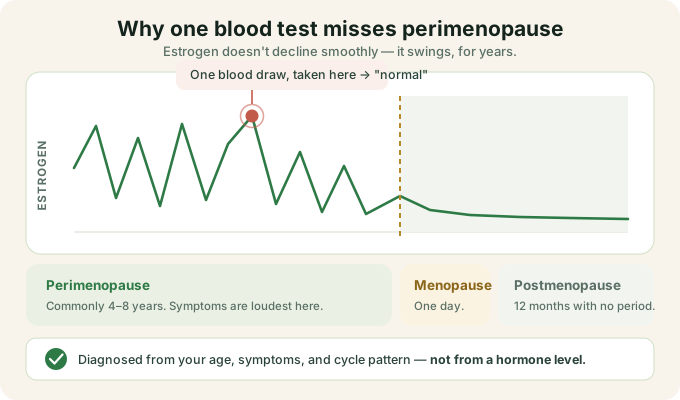
Menopause is a single point in time — the day you have gone twelve consecutive months without a period. Everything leading up to it is perimenopause, and everything after is postmenopause.
During perimenopause the ovaries do not wind down smoothly. Estrogen becomes erratic rather than simply low, swinging high and then dropping sharply, sometimes within the same cycle. Progesterone tends to decline earlier and more steadily as ovulation becomes less reliable. Much of what women feel in their forties comes from that instability — the change in the signal rather than its absolute level. It is why symptoms can be severe one month and absent the next, and why “I feel like myself again, so I must have imagined it” is such a common experience.
The symptoms that rarely get named
Beyond the ones everyone knows, these come up constantly and are seldom connected to the underlying cause:
- Waking at 3 or 4 a.m. and not getting back to sleep. Often the first symptom, and often the most corrosive, since almost everything else gets worse without sleep.
- New or amplified anxiety. Not situational worry — a physical, unfamiliar edge. For some women it is the single most disruptive symptom.
- Word-finding trouble and mental fog. Frightening if you are not expecting it. It is common in perimenopause and generally improves; it is not early dementia.
- Joint and muscle aches, particularly in the mornings, without a corresponding injury or workload.
- Heart palpitations — flutters or a racing sensation, often at night. Worth mentioning to a provider so cardiac causes are ruled out, but frequently hormonal.
- Skin and hair changes. Dryness, new sensitivity, thinning at the temples or part line, more shedding in the shower.
- A changed body shape at a stable weight, with fat redistributing toward the midsection, and previously reliable diet and exercise no longer producing the same results.
- Loss of libido, vaginal dryness, discomfort with sex, and more frequent urinary tract infections.
- Cycle changes — shorter intervals, heavier flow, occasional skipped months.
Why your labs came back “normal”
This is the most useful thing to understand, and the part that is most often mishandled.
Perimenopause is diagnosed clinically — from your age, your symptoms, and your cycle pattern — not from a blood test. Because estrogen and FSH fluctuate dramatically from day to day and cycle to cycle during this stage, a single blood draw captures one arbitrary moment in a moving system. You can be squarely in perimenopause and have a completely unremarkable panel drawn on the wrong day. A “normal” result does not mean your symptoms are not real and does not rule out perimenopause.
The corollary is equally important: an abnormal result on one draw does not confirm much either. Neither major professional guidance nor good clinical practice supports diagnosing perimenopause in a woman in her forties with typical symptoms on the basis of hormone levels alone.
Be cautious, too, with the elaborate salivary and multi-point hormone panels marketed heavily in the wellness space. They are expensive, they are often not well validated against clinical outcomes, and an impressive-looking report does not by itself make a treatment plan better. If you are shown a large panel, it is fair to ask what each result would actually change.
What is worth testing
Testing has a real role — it is mostly about ruling things out and establishing a safe baseline, not about proving perimenopause.
- Thyroid function (TSH, and free T4 if indicated). Thyroid disease is common in this age group and imitates perimenopause almost perfectly — fatigue, weight change, mood shifts, hair thinning, temperature intolerance. It should be checked in essentially everyone with these symptoms.
- Complete blood count. Heavy perimenopausal bleeding is a frequent cause of iron deficiency, and iron-deficiency anemia produces fatigue, breathlessness, and hair shedding of its own. It is common, easily treated, and routinely missed.
- Ferritin. Iron stores can be depleted well before anemia is visible on a CBC.
- Metabolic markers — fasting glucose or A1c, and a lipid panel. Cardiovascular and metabolic risk changes meaningfully around the menopausal transition, which makes the forties a sensible time to establish a baseline regardless of symptoms.
- Vitamin D. Often low even in Florida, since most of us are indoors or wearing sunscreen, and relevant to bone health as estrogen declines.
- FSH and estradiol — useful in specific situations, such as suspected premature ovarian insufficiency under 40, an unclear picture after hysterectomy, or symptoms that do not fit. Not required to make a routine diagnosis in your forties.
If a symptom does not fit the pattern — bleeding between periods, bleeding after sex, any bleeding after twelve months without a period, a new lump, or unexplained weight loss — that needs its own workup rather than being folded into a hormone story.
What is actually treatable
A good deal of it, and not all of it is hormonal.
Hormone therapy is the most effective treatment available for hot flashes and night sweats, and it helps many of the sleep, mood, and genitourinary symptoms as well. The risk-benefit calculation has been substantially revised over the last two decades, and for most healthy women starting within about ten years of menopause the balance is more favorable than the early 2000s coverage suggested. That said, it is genuinely individual — personal and family history of breast cancer, clotting disorders, cardiovascular disease, and migraine with aura all change the calculus, and route of delivery matters. This is a conversation about your history, not a categorical yes or no. Options and monitoring are covered in more depth by our sister practices’ overviews of hormone therapy and hormone replacement.
Vaginal estrogen deserves separate mention because it is widely underused. Local low-dose therapy treats dryness, discomfort, and recurrent UTIs with minimal systemic absorption, and it is appropriate for many women who are not candidates for systemic hormone therapy.
Non-hormonal options exist for women who cannot or prefer not to use hormones, including several prescription medications with real evidence behind them for hot flashes.
Some of it responds to things that are not prescriptions. Resistance training does more for the midlife shift in body composition, bone density, and insulin sensitivity than any cardio protocol, and most women in their forties are not doing enough of it. Protein intake usually needs to go up. Alcohol reliably worsens both sleep fragmentation and hot flashes, and cutting it is often the single highest-yield change.
The downstream symptoms have their own answers. Hormonal hair thinning at the part line may respond to PRP hair restoration alongside addressing the underlying cause. Metabolic stall that has not budged with diet and exercise is worth a structured, supervised approach rather than another round of self-blame — that is what medical weight loss is for. Facial volume changes have their own set of options, separate from anything hormonal.
When it is not hormones
Thyroid disease, anemia, depression, sleep apnea, and medication side effects all overlap heavily with this symptom set, and more than one can be true at once. Sleep apnea in particular rises in women after menopause and is under-diagnosed because the presentation differs from the classic picture. Being told “it’s just perimenopause” without anything being checked is not a diagnosis — it is a shrug.
Getting a real evaluation in Jacksonville and St. Johns
Our functional wellness visits are built for exactly this: a long enough appointment to take a real history, sensible testing chosen for what it will actually change, and a plan that gets adjusted as things move — because in perimenopause they will. We see patients from Jacksonville, St. Johns, Ponte Vedra, Nocatee, Mandarin, Julington Creek, Fleming Island, and St. Augustine at our Durbin Park office.
If you have spent two years being told your labs are fine while feeling distinctly not fine, that experience is common enough to be a cliché — and it is not a reason to stop asking.
Care is provided at our St. Johns County office in the Durbin Park area — serving Jacksonville, St. Johns, Ponte Vedra, Mandarin, Durbin, Silverleaf, Nocatee, Julington Creek, Fleming Island, and St. Augustine.
Keep reading
Ready to talk it through with a vein specialist?
Cristal Boatright, PA-C reviews your history and maps a plan built on real diagnostics — not a template.
Book a consultationOr call/text (904) 310-7186.
Sources & further reading
- Hormone pellet therapy — Miami Vein Center
How hormone therapy is delivered and monitored.
- Hormone replacement therapy — Miami Skin Spa
Sister-practice overview of hormone replacement options.
- Bioidentical hormone therapy — Miami Vein Center
What bioidentical means and how dosing is monitored.
- DEXA body composition & bone density scan — Miami Vein Center
Bone density measurement, which matters as estrogen declines.
- Functional medicine program — Miami Vein Center
The evaluation model behind a longer, history-first visit.