Does Ozempic Cause Hair Loss? What Jacksonville Patients Should Know

Does Ozempic cause hair loss?
Ozempic and other GLP-1 medications do not appear to poison your hair follicles directly. When hair shedding shows up during treatment, it is almost always a temporary condition called telogen effluvium — a reaction to rapid weight loss, reduced calorie and nutrient intake, and the physical stress your body goes through while it changes quickly. It does not happen to everyone, and for most people it eases as weight and nutrition stabilize.
If you have been reading worried posts online, that context matters. The medication itself is not thought to be attacking your hair. What tends to trigger shedding is how fast the weight comes off and whether your body is getting enough of what it needs along the way — both of which are manageable with the right support.
What “Ozempic hair loss” actually is
Your hair grows in a cycle. At any moment, most follicles are in a growing phase, and a smaller share are in a resting-then-shedding phase. When the body experiences a significant stressor — a big illness, surgery, childbirth, a crash diet, or dramatic weight loss — it can push a larger-than-usual number of follicles out of the growing phase and into the resting phase all at once. A couple of months later, those resting hairs let go together, and you notice more strands in the brush, the shower drain, or your ponytail.
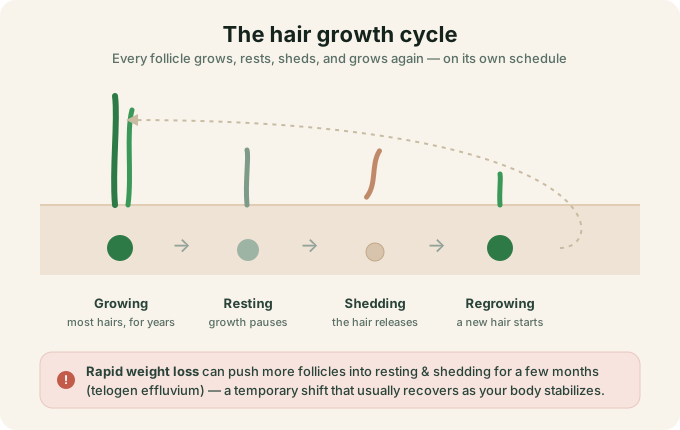
That delayed pattern is the hallmark of telogen effluvium, and it is the mechanism behind most GLP-1–related shedding. It typically shows up two to three months after the stressor rather than the moment you start the medication. It usually causes diffuse thinning across the whole scalp rather than distinct bald patches, and — importantly — the follicles are not permanently damaged. They have hit pause, not stopped.
Is it the drug, or the weight loss?
This is the honest heart of the question, and the evidence points more toward the weight loss than the molecule. Semaglutide (the active ingredient in Ozempic and Wegovy) and tirzepatide (in Mounjaro and Zepbound) both work by curbing appetite and slowing digestion, which naturally leads to eating less and losing weight, sometimes quite quickly. Rapid weight reduction from any cause — bariatric surgery, aggressive dieting, serious illness — is a well-recognized trigger for telogen effluvium.
The clinical trials do show a real signal, and it is worth being straight about. In the weight-management studies, hair loss was reported meaningfully more often than with placebo — several times more often in the tirzepatide trials — and it clustered among people taking the higher-dose weight-management versions and those who lost the most weight. It was also reported notably more often in women than in men. All of that fits the “rapid stress and change” explanation rather than a direct toxic effect on the follicle: the more dramatic and fast the weight loss, the more the hair cycle tends to react. It is also why you will hear the same worry attached to Wegovy, Mounjaro, and Zepbound — it is less about which brand is in the pen and more about the pace of change your body is adapting to.
None of this means the shedding isn’t real or upsetting — losing hair is genuinely distressing, and for some people it is more than a trivial amount. It simply means the cause is usually addressable, and that is the encouraging part.
What helps reduce and reverse it
Because GLP-1–related shedding is tied to how you lose weight rather than a fixed side effect, the levers that help are mostly about pacing and nourishment:
- Aim for gradual, steady weight loss. A slower, more sustainable pace gives your hair cycle less of a shock. Careful dose adjustment is one way a provider can help keep the rate of loss in a healthier range.
- Prioritize protein. Hair is largely protein, and appetite suppression can make it surprisingly easy to under-eat. Meeting your protein needs each day supports the follicles as well as your muscle mass.
- Watch key nutrients. Low iron — along with shortfalls in zinc, vitamin D, or overall calories — can worsen shedding, and targeted bloodwork can flag these so they are corrected rather than guessed at. (Biotin is a common exception to the hype: true biotin deficiency is uncommon in people eating a normal diet, supplements are not shown to help shedding when you are not deficient, and high-dose biotin can actually skew certain lab results, so it is not a routine fix.)
- Give it time. Once weight and nutrition level off, the resting follicles generally cycle back into growth. Regrowth is gradual — often noticeable over several months — so patience is part of the plan.
This is exactly where doing the program under medical supervision changes the experience. A physician-supervised medical weight loss program can set a sensible pace, check your labs, keep your protein and nutrients on track, and adjust your plan if shedding appears — rather than leaving you to troubleshoot it alone from a pharmacy pickup. If you are still deciding whether this path fits you, it helps to understand how medical weight loss actually works, from evaluation to the ongoing check-ins that catch issues like this early.
When shedding needs a closer look
For most people, patience plus good nutrition is enough, and diffuse shedding resolves on its own. But not all hair loss is ordinary telogen effluvium, and a few features deserve prompt evaluation rather than watchful waiting. Check in with a clinician sooner if you notice patchy or coin-shaped bald spots rather than all-over thinning; redness, scaling, tenderness, or scarring on the scalp; shedding paired with symptoms like fatigue, feeling cold, or changes in your menstrual cycle (which can point to a thyroid issue); or shedding that is unusually heavy or still getting worse beyond about six months. These can signal conditions unrelated to weight loss that respond better to earlier treatment.
When to look at hair-specific treatment
Sometimes hair thinning lingers, or the GLP-1 experience simply uncovers a pattern of hair loss that was already underway — such as female or male pattern thinning that gradual aging or genetics were quietly driving. In those cases, waiting alone may not fully restore density.
That is when it can be worth having your scalp and shedding pattern evaluated so treatment can be individualized. Depending on what your provider finds, in-office hair regrowth treatments such as PRP (platelet-rich plasma) may be an option to help support the follicles, often alongside the same nutritional groundwork. Some clinics also offer newer exosome-based therapies; it is worth knowing that these are still considered experimental for hair loss and are not FDA-approved for this use, so they should be discussed as an emerging option rather than an established one. The right approach depends on whether you are dealing with temporary shedding, an underlying pattern, or a combination — which is why an evaluation comes before any recommendation rather than after.
Should worry about hair loss stop you?
For most people, no — but it is a fair reason to be thoughtful about how you pursue weight loss. The shedding some people notice on Ozempic, Wegovy, Mounjaro, or Zepbound is usually a temporary, reversible response to fast weight loss and dietary change, not lasting damage from the drug. It does not affect everyone, it appears more commonly in women and at higher weight-loss doses, and it can often be softened by losing weight at a measured pace with proper nutrition and monitoring.
If you are considering one of these medications in St. Johns, Jacksonville, Nocatee, Durbin, or elsewhere in Northeast Florida, the most reassuring step is simply to do it with guidance. A supervised plan is designed to help you lose weight in a way your whole body — hair included — can keep up with, and to have real options ready if concerns come up along the way. Your provider can help determine what pace, nutrition plan, and follow-up make the most sense for your situation.
Care is provided at our St. Johns County office in the Durbin Park area — serving Jacksonville, St. Johns, Ponte Vedra, Mandarin, Durbin, Silverleaf, Nocatee, Julington Creek, Fleming Island, and St. Augustine.
Ready to talk it through with a vein specialist?
Cristal Boatright, PA-C reviews your history and maps a plan built on real diagnostics — not a template.
Book a consultationOr call/text (904) 310-7186.
Sources & further reading
- Medical weight loss — Miami Skin Spa
Supervised weight-loss programs at our Miami sister practice.
- Microneedling for hair & skin — Miami Skin Spa
One of the in-office options that supports hair and skin.